AI Across the Country
Escaping the bubble

I just got back from over two weeks of travel, crisscrossing the country and meeting with a variety of business leaders, technology executives, regulators and government officials, and of course, startups. The diversity of perspectives on, and experiences with, AI was in turns contradictory, illuminating, and exciting.
There is something to be said for back-to-back hops in different geographies and environments to highlight differences in how various audiences are approaching this new technology. Since July 20th, I’ve attended a gathering of banking regulators and policy-makers, a major corporate VC event, met with one of the world’s biggest asset managers, attended a dinner with some of the most successful fintech companies of the past decade, went to the largest annual AI conference in Vegas (Ai4), and I just wrapped up Defcon, a very technical hacker conference heavily focused on security.
The biggest distinction I saw was between AI Strategists and AI Doers. Unlike crypto, where there were (and are) plenty of actors who have no interest in the product and can happily ignore it, everyone I met was deeply focused on AI as a topic and aware that it was going to usher in dramatic changes to their respective worlds, whether they liked it or not. Where they differ is on how they’re thinking about it: whether as something to be employed in their daily lives and businesses; or as something about which to have an opinion.
The corporations, the regulators, and the corporate conference crowd see AI as something on which they ought to act and for which they need a “strategy.” Meanwhile, the startup founders and the engineers view it as an input into their businesses that opens up new opportunities for building and new threats to their security, both technical and economic.
Even that distinction, though, doesn’t describe the full diversity of views I observed. Within the Strategists, there are the corporations, many of whom are in Pilot Purgatory, there are the AI boosters on The Circuit of conferences, cocktail parties and Twitter takes, and the lonely regulators, policymakers, and think-tankers in Vertigo City.
In contrast to this group are the Doers: the AI Maximalists and the Sanguine Developers.
The Doers
AI Maximalists
This group is my tribe, most of our portfolio, and 90% of the people I interact with most days. They were extremely well-represented in my founder meetings and at an excellent dinner that my friend Tom Brown organized with Eric Glyman and many other startup luminaries.
One representative conversation: I spoke with a brilliant developer who is building a 30-agent cluster with a shared SQL database for memory, all running open-weight models locally on on-prem equipment that their company can sell en-masse to security-conscious companies. His concern is how many GPUs he can jam into a rack.
These founders don’t have a “unique perspective” on AI, just like military generals don’t have a “unique perspective” on national defense. AI is, rather, the water in which they swim. Instead of worrying about vague “principals”, “strategies”, or “regimes,” they worry about moving faster, controlling token cost, managing agentic coordination, using context windows efficiently, sharing memory, and figuring out how to get their developers access to the best models without bankrupting their companies. They’re at war, and like generals at war, they are using the best tools for the right task as efficiently as possible, to win.
Needless to say, most of the actual forward motion and innovation outside of the frontier labs is occurring here.
The Sanguine Developers
Very well-represented at Defcon. These engineers have been around for a long time and remember the “information superhighway,” cloud computing, crypto, SOA, XML, and an endless supply of “revolutionary new programming paradigms” and “world-changing data structures.” To this crowd, “AI” is pretty much just another tool: sudo apt install ai and hope it doesn’t screw everything up (and it probably will, and they have good backups, because again, not their first rodeo). A lot of the Sanguine Developers are employed by the Maximalists, and they’re distressingly aware that, whatever magic AI can summon, it can also break things in truly spectacular fashion.
At Defcon especially, the view that the frontier labs have limited defensibility and zero moat was nearly unanimous. Almost everyone expects costs to come down dramatically and security to suffer. They may be a bit less enamored of the future than the Maximalists, but they are no less aware that things are changing, and even if they might not admit it on stage, I think they’re a bit excited about all of this, too.
The Strategists
Pilot Purgatory
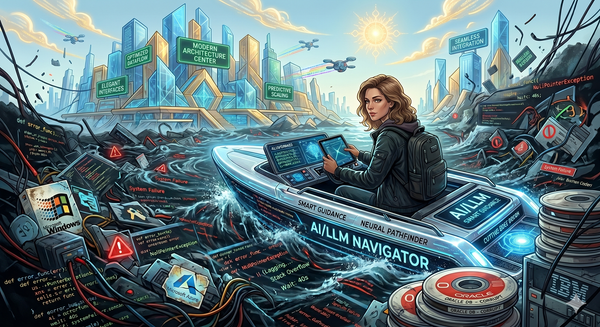
The forward-thinking corporations are fully aware that these tools represent a massive paradigm shift and want to catch the wave. The thoughtful firms really are doing everything right, and it’s still not even close to enough. They’re piloting everywhere they can, trying to execute on partnerships, and—in some cases—even investing in innovators. The problem is decades of accumulated processes that must be rebuilt to exploit the new technology. You can stick an elevator inside a nineteenth-century hotel, but it’s going to be hard to compete with a 50-story glass-and-steel skyscraper. Even within startups, those formed several years ago are failing to realize gains from AI as efficiently as those formed in the last two years.
Large companies also have a lot of existing assets (figurative and literal) to protect. They are never going to install OpenClaw and see what happens, nor should they. That inability to experiment, though, is a massive handicap that opens them up to potentially devastating disruption.
Even with good leadership, these large corporations are like cruise ships racing against speedboats: they have a lot of inertia and accumulated resources but are slow and complex. The more technology shifts, the more exposed they become, and technology has never shifted so quickly. There is some evidence that racing to catch up has actually caused productivity losses for legacy corporations. That said, their size, profitability, and inertia also protect them from immediate death, and they are much less likely to capsize than any individual startup.
The Circuit
Ai4 was enjoyable, but the truth is that it could have been almost any big Vegas conference: Comdex, Money20/20, CES, etc. It’s composed of the same type of people hawking the same products, telling the same stories, having the same kids of opinions, wearing the same sportscoats, and all desperately chasing email signups (you learn to be at least a little evasive at these events, lest your inbox explode forevermore).
This conference overlapped with the Great Agentic Hugging Face Hack of 2026, and the reaction to it was—almost to a person—“this is why you should buy my product” (either because it would never ever do that or because it magically would have defended against such an attack). It felt like attending RSA after North Korea did something.
Basically, there’s a lot of money to be made in talking about AI, even if the products are pretty darn derivative of what the major labs have already built.
Vertigo City
Similar to how the big corporations are fully aware of what’s happening, the more technically-minded regulators, policymakers, and think-tankers fully appreciate the major shift happening, and they’re getting a bit motion sick up there. Whether we like it or not, AI is most certainly a political issue and will remain one for the foreseeable future.
Almost everyone had used an LLM to build something (really!), largely out of a desire to explore and learn. There was practically unanimous agreement that the current frameworks are increasingly irrelevant and ineffective, but with technology’s changing so quickly, there was not even a remote consensus on how best to react. While it’s easy to roll one’s eyes at this inaction, I respect it, along with the caution and self-awareness among this group. They’re not pretending to be experts or to have all of the answers to an “easy” problem.
I’ve written before about how AI is not social media, and the knee-jerk “ban it all! (except for a favored lab or two)” approach that we saw in the last administration would have been the worst possible outcome, insulating incumbents from competition and doing nothing to prevent other nations from continuing to make progress. While frontier-class open-weight models may be bad (possibly existentially so) for Anthropic and OpenAI, they will be a massive boon to the rest of us and to the global economy. Bringing down the cost of intelligence is a good thing (at least assuming you like economic growth), and the goal of regulation ought to be broader than protecting the earnings of two US companies.
Expect regulations to continue to be ad-hoc and implemented only after major disasters or near-misses, despite everyone in a position of authority fully understanding how risky of an approach that is. As the old joke goes, it is, perhaps, the worst option . . . except for all of the other options.
In Conclusion
This truly is the most exciting time imaginable to be in technology. There is nowhere else I’d rather be. Everything is changing, everybody knows it, and nobody really has any idea where all of this is headed (those on The Circuit pretend to, of course). Despite all of that uncertainty, I came away more convinced than ever that the major productivity gains of AI will inure far more to startups than to anyone else. They are just built for this, from day one.
To be sure, the incumbents are far from dead, regulators far from clueless, and AI bloviators will make plenty of money on the speaking circuit for the foreseeable future (so many emails). All that said, seeing these various groups one after the other was a delightful exercise in contrasts and sharpened my conviction that the structural advantages that startups have in this moment are likely impossible for their competitors to overcome.
As for me, after two weeks spent half in east coast humidity and half in the 115° Vegas heat, I’m really looking forward to being able to go for a run outside without dying.