Against Claude Code
Never Again


Don’t Get Trapped
Despite how impressive it is, I’m staunchly opposed to heavily adopting Claude Code into my daily workflow. The reason has nothing to do with AI—I love AI and use it constantly—but rather it’s because I’m typing this post on a computer running Windows 11.
I joked with a founder a couple days ago that I’m using Windows because I made a tragic mistake a quarter-century ago, and while I was trying to be funny, the more I thought about it the more I realized it was literally true (and then I thought, “I bet there’s a blog post in there!”). I’m stuck using this garbage OS[1] because I know it, I rely on a lot of Win32 software, and, frankly, because the OS layer just isn’t that important anymore. As long as it continues to be able to run a browser, it’s good enough, I suppose. Still, it sucks.
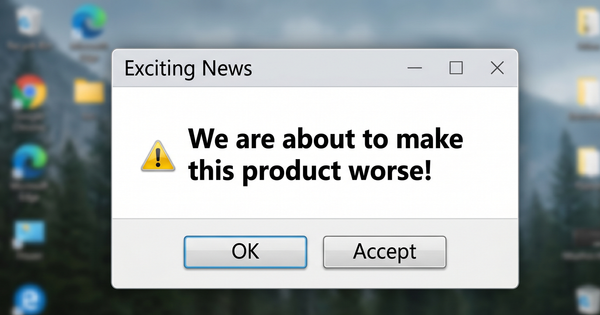
The lesson: avoid going all-in with products that are likely to screw you some day. Windows 2000 was a really solid OS, but Microsoft’s business model gradually flipped from “build a product people want to use” to “exploit users who need the product.” And here we are: every time Windows updates, I need to uninstall Candy Crush.
Sometimes, this just doesn’t matter that much (I switched from placing Google at the center of my web experience to Kagi in about five minutes). There’s no need to be a purist about it, lest you descend into Stallman-esque madness. For the things that really matter, though, I think it’s worth tolerating some friction now for freedom later.
Your AI harness really matters. It might be the most important piece of software you ever run, especially for technical people, founders, and developers. Tying that harness to a frontier lab is a terrible decision.
The models themselves are commodities, with various providers’ outracing each other every few months. Everyone knows this, the companies themselves most acutely. You can see the business model evolving: if we can’t capture the user with the model, we’ll capture them with the harness.
When OpenAI launched GPT-5, the point was to save money, and the model was, predictably, worse. Users freaked out, and OAI backpedaled. It was easy enough just to switch models and providers back then; it turned out that users had a lot of power because the harness was loose (or nonexistent).
If you’re using Codex for your entire workflow, though, it’s a different calculus. You’re stuck. Do you really have time to port your entire workflow to a competitor? Before you say “yes, absolutely; I always use the best tools” consider that you have a project deadline in 48 hours and an open issues list with six thousand bug reports. You’re never going to do this, especially if they keep the degradation to a gradual pace. Look, Oracle exists. Q.E.D.
Moreover, the cash burn of the frontier companies is absolutely out of control—almost unlike anything we have seen, and there is a very high likelihood that total panic will set in after the first busted IPO or cash squeeze. It is easy to naively separate the world into “good” and “bad” CEOs, but the truth is that even the most pure CEO will turn desperate at the prospect of his company’s going bankrupt. If you haven’t run a company, it is hard to appreciate the agony of watching your checking account tick towards zero while dozens, hundreds, thousands of people depend on it for their paycheck to clear.
Open Source is Increasingly Powerful
I’m hardly the first person to make this observation, but LLMs have made open source software vastly more valuable. Historically, OSS was mostly appealing because it lacked the perverting incentive structures that lead to Candy Crush ads in Windows. (Of course, it also lacked the incentive structures for fixing problems that normal people cared about.)
We forget that the original argument for OSS had nothing to do with incentives or purity of spirit but about being able to solve your own problems. As software became more complex, however, it became impossible for regular users to edit code and impractical even for developers to do so.
LLMs completely alter the landscape. It has become very easy to tweak software by using an LLM to help out. Over time, as the models improve, the accessibility bar will lower to encompass more and more users.[2]
Long Live OpenClaw!
I’ll admit that OpenClaw, from a software perspective, is kind of a disaster—“massive breaking change introduced” is synonymous with “Tuesday” in that repo—and that Claude Code is arguably more elegant and better integrated with Opus than Cursor is. Still, I believe with near-certainty that the entire point of Codex and Claude Code is vendor lock-in, and I’m just not making that mistake again.
Maybe I’ll be a bit less productive today, but Future Tyler is going to thank me for it.
Sadly, the actual operating system stuff like the scheduler, window manager, I/O subsystem, etc. are quite good and in many ways better than the kludgy BSD-with-an-ugly-UI-grafted-onto-it mess that is OSX/MacOS. But Microsoft destroyed userland because of their wretched org structure and ridiculous internal KPIs, while Apple so far (mostly) hasn’t. ↩︎
Brief personal anecdote: our HOA wanted a newsletter; I offered to spin up Ghost newsletter for them. It turns out that Ghost has an unfortunate design quirk that I didn’t appreciate: there’s no way to completely hide a post title and image—just the content. This obviously makes sense for a typical newsletter that wants to tease paywalled content, but it’s a terrible design for a private community. Claude told me how to adjust the template files directly, and even though this use-case isn’t contemplated by the devs, it took about ten minutes of work to implement it. Had I gone with a hosted or closed-source version, we’d have been completely stuck, but in the pre-LLM days, figuring out how to modify the underlying system would have been a big, time-consuming task that I probably wouldn’t have undertaken anyway as just a volunteer. ↩︎